
March 17, 2023
Employee Engagement

What is employee engagement?
Employee engagement may be defined as the degree to which employees are emotionally committed to their work, organization, and goals. Engaged employees are:
- enthusiastic about their work,
- motivated to contribute to the success of their company, and
- willing to go the extra mile to help achieve its objectives.
Though employee engagement, happiness, and job satisfaction are related, they aren’t the same. Engaged employees may not always be happy with every aspect of their job, but they are committed to the larger purpose of their work. They feel a sense of ownership in the success of their organization.
You can measure employee engagement through surveys, interviews, and other methods of assessing employee attitudes and behaviors. Organizations prioritizing employee engagement tend to have higher innovation, productivity, and retention levels.
What are the different levels of employee engagement?
Employee engagement evaluates how employees feel about the organization they work. Depending on their perceptions of their workplace, you can categorize employees into four major groups. Let us learn what levels of employee engagement are and what they are about.
Highly Engaged Employees
An employee who is fully committed and quite involved in their work is an engaged employee. They are motivated enough to accomplish their organization’s goals and have a positive attitude toward their work. Likely, engaged employees make efforts to contribute to the success of their company, surpass expectations, and show their loyalty to their employer. Most importantly, highly engaged employees act as brand advocates for their company. They also motivate others around them to do their best.
Moderately Engaged Employees
If you are a moderately engaged employee, you will view your organization reasonably favorably. Moderately engaged employees like their company, but they see that there are chances for improvement on the part of their organization. They won’t ask for more responsibilities and may even underperform. Something about their job or the organization holds them back from engaging fully.
Barely Engaged Employees
Employees who feel indifferent towards their workplace are called barely engaged employees. Generally, they are demotivated to work and only do as much as possible. They aren’t ambitious in their current job and hence, achieve less. You may be looking for other jobs if you are a barely engaged employee. So, they are responsible for a high attrition rate.
Disengaged Employees
They are the ones who bear a negative opinion of their workplace. Disconnected from the organization’s mission, vision, goals, and future, disengaged employees do what is expected but lack zeal and passion. They don’t look for ways to hone their performance or contribute to the organization’s success. As they miss any commitment to their position at the company and responsibilities, you must learn how to tackle disengaged employees, or else their negative perceptions affect the productivity of those around them.
Actively Disengaged Employees
These employees are totally unhappy and discontent with their job. They have a negative attitude towards their employer and the work environment. They aim to make efforts and weaken their organization without caring about its success. Such employees depress other employees, bringing down their morale and productivity.
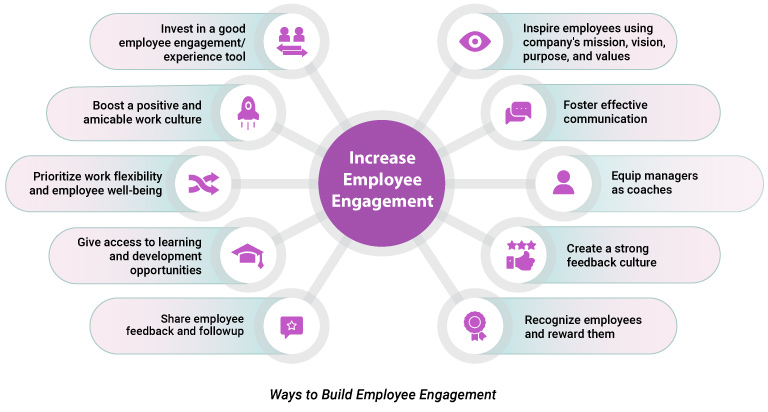
As leaders, you must endeavor to boost employee engagement levels, and you can do this:
- by providing competitive compensation and benefits to your employees,
- by nurturing a positive work environment,
- by bringing in opportunities for professional growth and development, and
- by furthering a culture of employee empowerment and open communication.
Promoting Employee Engagement
Relevance and Benefits of Employee Engagement
Let us now learn what makes employee engagement relevant for organizations of today:
- It is well-known that well-engaged employees tend to be more productive than disengaged ones. With a better focus on their work, they take the lead, make efforts, and are ready to go that extra mile to achieve the set goals.
- Engaged employees offer improved customer service. Your clients are satisfied with their services, ultimately leading to customer loyalty.
- You also improve employee retention with employee engagement. There is less probability of your employees leaving the job, being happy and content at work. Due to the mitigated attrition rate, you reduce costs related to hiring and training new employees.
- Improved employee engagement leads to higher business profitability. When customer service betters, your customers are satisfied, employees are happy and don’t want to leave, and you book profits while decreasing hiring costs.
- As you promote employee engagement, you foster a positive workplace culture. Your team becomes not only more productive but also cohesive. They collaborate and communicate for good, resulting in a gratifying work environment.
- Nobody can deny the truth that engaged employees are more creative. They grow innovative and like contributing fresh ideas. This, of course, leads to honed processes and bettered products.
- Engaging employees is not just meant to boost your business’s growth. One of the employee engagement strategies is to offer them learning opportunities. They, thus, grow and develop professionally and personally while advancing their career.
Understand that employee engagement is crucial for the success of your organization. Fostering a work environment that boosts employee engagement to accomplish the benefits above should be at the top of your priority list.
Top Drivers of Employee Engagement
Various major drivers lead to employee engagement and, thus, organizational success. Let us visit a few of such top drivers.
Communication
Without effective communication, you cannot create a positive work environment or a good work culture. It is critical for leaders to win their employees’ trust and entrust their people. Expectations should be set before. Besides, there should be effective feedback and 1-on-1s, and an open dialog. Employee engagement software can be of much help here. This way, you can keep your employees engaged.
Leadership
What matters most to your employees is how you treat them as leaders. Show great leadership skills and encourage and support them in every way possible. Empower your direct reports and teams as they look up to you. Think of your reports and team before yourself. Only then you can expect them to be motivated, engaged, and productive.
Career Advancement
Your employees should have enough scope for career advancement. This implies you must provide them with ample learning opportunities while on the job. Your people must feel they are growing professionally, not just meeting the targets. Mentoring, training, and enabling your employees to enroll in courses or programs that benefit or interest them help them feel valued and invested.
Fairness and Equality
Forget about biasedness. Treat your staff fairly and equally. Nobody should ever feel any partial behavior from their manager. Lay down clear expectations. Most importantly, fair compensation and equal career growth and development opportunities should be provided.
Work-life Balance
This area is the most affected one. Since the remote working model hit the globe, employees have failed to maintain their work-life balance. Most of the time, they work and invest long hours in meetings, doing more than expected. This ultimately disturbs their family life and health, resulting in a decrease in their engagement and productivity. Flexible work schedules or paid time off (PTO) help them maintain a fair work-life balance.
Organization’s Culture and Values
Your employees thrive in a positive work culture, a workplace culture that aligns well with their values. Your people should feel a sense of belonging. When employees have a common purpose and share values with the team, they are more engaged and committed.
Recognition
Nothing can beat the power of recognition, and recognition need not always be monetary. You can appreciate an employee’s contribution to a project by praising him on the “Wall of Fame”; an employee experience platform enables you to do that easily. Who doesn’t like being recognized in front of the entire organization? Besides, there are gift cards, bonuses, promotions, holiday packages, etc., to keep your employees happy and engaged.
As a leader, focus on these drivers of employee engagement and breed a positive-cum-productive work culture. Your goal must be to promote employee performance, loyalty, and retention.
How is employee engagement measured?
You can measure employee engagement employing several methods, and those include:
Employee Surveys
It is the standard method of measuring employee engagement. In employee surveys, you ask employees about their attitudes and perceptions of their job. You also ask your people about their co-workers and the organization. Managers can monitor employee surveys in-person or online. Remember, a meticulously designed and well-conducted employee survey helps reveal much information management should use to improve the quality of work and the workplace. As an organization, when you respond to employee feedback, there is a higher employee retention rate, better productivity, less absenteeism, greater employee morale, and improved customer service.
Interviews
You can find out if your employees are engaged by conducting one-on-one interviews. HR personnel, managers, or third-party consultants interview employees to see if they are happy and content. Such interviews can offer valuable insights into the work experiences of individuals. You can thus develop a plan of action. Interviewers can share the findings of these interviews with their teams to build specific effective employee engagement strategies.
Focus Groups
You can assess employee engagement through focus groups too. They are small, informal discussions that you have with your employees. The objective of having these focus groups is to collect employee feedback and the experiences they have at work. Focus groups are better than surveys, giving more in-depth information but are time-consuming and intensive on resources.
Social Media Monitoring
Today, social media has emerged as a helpful tool for assessing employee engagement. Employees feel free to share their thoughts and feelings about their job and company on social media. Companies may learn better about their employees through social platforms. As you monitor social media channels, you gain valuable insights into employee sentiments and recognize areas where improvements must be made.
Performance Metrics
Another way to measure employee engagement is through performance metrics. These performance metrics may be the rate of absenteeism, employee retention rate, level of productivity, employee satisfaction scores, and employee net promoter score (eNPS). Employee retention rate evaluates the percentage of employees staying with the organization over a particular period. A higher retention rate shows employees are engaged and committed to their job and the organization. Similarly, a higher employee satisfaction score or ESAT indicates employees are quite satisfied with several aspects of their job and work environment, including compensation, work-life, benefits, etc.
In entirety, measuring employee engagement calls for aggregating qualitative and quantitative methods. You thus get a complete understanding of your employees’ behaviors, perceptions, and attitudes. As you analyze employee engagement data, you identify where you must improve and act to create a highly engaged and productive workforce.
Role of an Employee Engagement Software
Talking of an employee engagement software, it plays a significant role in bettering employee engagement. It is nothing less than a centralized platform for organizations to track and manage employee engagement activities effectively.
How an employee engagement tool supports employee engagement efforts and activities:
Administering Surveys
Employing an employee engagement tool enables you to supervise employee surveys. Thus, you can collect feedback on employee engagement levels, satisfaction, and other key metrics.
Analyzing Data and Reporting
Organizations can analyze data gathered from employee surveys and generate reports. These reports show how employees feel about their job and the organization, if they are happy and satisfied, ongoing trends in employee engagement, and where the organization must improve engagement.
Recognizing and Rewarding Employees
An employee engagement or experience platform enables individuals to receive or give recognition. “Praise Wall” shows who all are praised for what and by whom. You can even view badges received by your team members in the team dashboard. You may search for your colleagues and teams to recognize them for their efforts. The recognition feature of an employee engagement tool thus helps to further employee engagement.
Collaborating and Communicating
The best part about employee engagement software is alignment. You can align your goals with those of your team and other teams through collaboration and communication. It is visible to employees working on what and how others contribute to meet their targets. Besides, there is 1-on-1 and feedback that increases communication between managers and their direct reports.
Providing Learning and Development Support
Employee engagement tools also feature learning, training, and development support. Employees gain access to courses to hone their skills and thus grow their careers. When people can take up programs that help them grow professionally for their current and future job opportunities, they are more motivated and engaged.
Managing Performance
Make employee engagement tools available and accessible to your employees so that you and they can track their performance and progress on their goals. Once you have set your employees’ goals in sync with the organization’s, you must check if they are trying to meet organizational goals. When employees feel their contribution makes a difference for the company, they feel more valued and engaged.
You have learned what employee engagement is, why employee engagement is important, how to improve it, and how you can create a difference through best practices and optimizing the use of technology. Remember, when you have a highly engaged and productive workforce, your business grows, and results improve too.
